



Loved this article?
Share it with the world.


When people talk about fertility, most of the focus is on women. But paternal age matters too and more than most men realise. Whether you are wondering about the best age to have a baby as a man, or how sperm quality changes over the decades, this guide from Dr. Mazen Dayeh’s fertility clinic in Sharjah serving patients from Dubai gives you clear, honest answers. The truth is yes. Age affects fertility in men as well, and it can have an impact on both the ability to conceive and the health of the baby.
Let’s break this down in simple terms so you understand what really happens with male fertility and age.
Age Affects Fertility
Many men assume they can father children at any age without a problem. After all, some celebrities become dads in their 60s or even 70s. While it is true that men can produce sperm throughout their lives, that does not mean fertility stays the same forever.
Research shows that sperm quality changes with age. The number of healthy, active sperm goes down slowly as men get older. It may not stop men from having children, but it can make it harder for their partner to get pregnant.
Male Fertility and Age
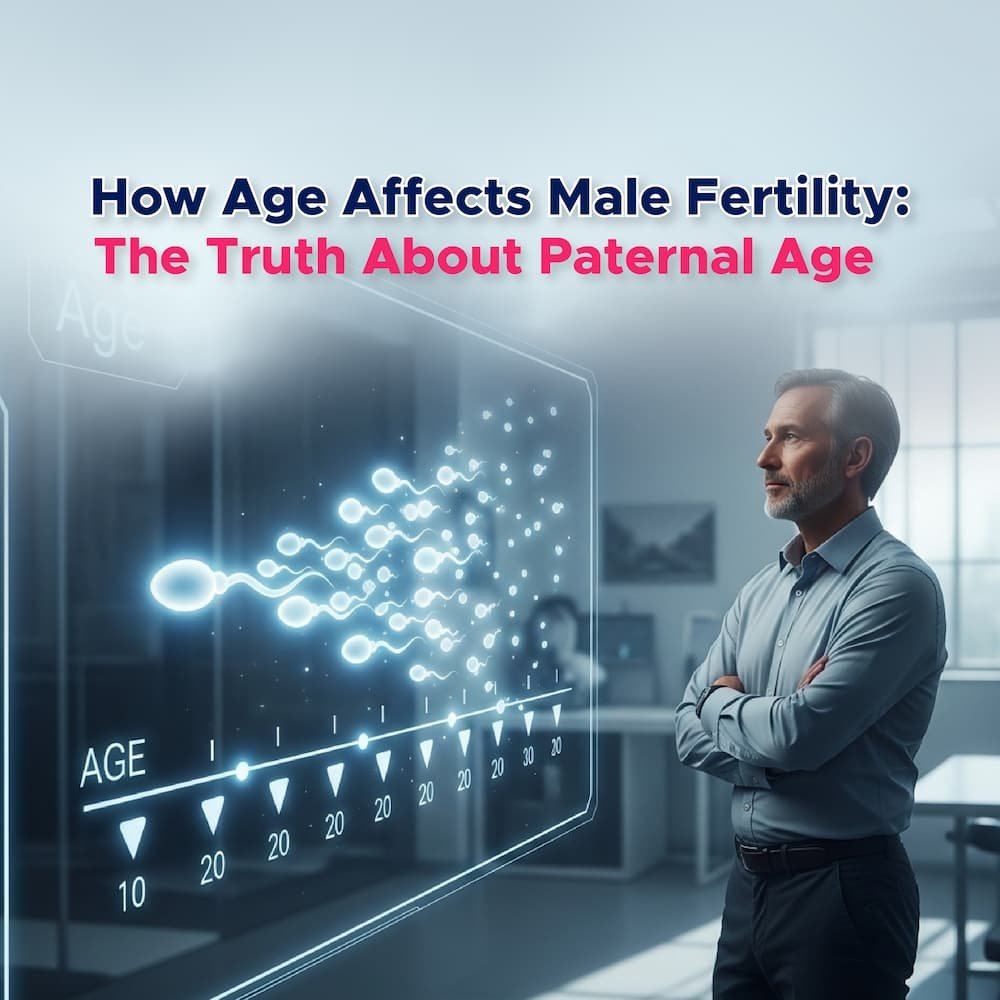
Sperm health is not just about numbers — it covers shape, movement speed, and DNA quality. Think of it as a male fertility age chart in plain language: in your 20s, sperm parameters are typically at their best; in your 30s, changes are subtle; after 40, decline becomes more noticeable; and after 50, both count and DNA quality drop further. Younger men generally have sperm that swim faster and carry fewer genetic errors. As men age, sperm are more likely to carry DNA changes.
This matters because sperm provide half of the genetic material for a baby. If the DNA is damaged or unstable, it can affect both the chance of pregnancy and the baby’s health.
ALSO Read: What is Male Fertility? Tips to Boost Male Fertility & Sperm Count
Does Paternal Age Affect Fertility?
Yes, paternal age does affect fertility. Several studies have shown that after the age of 40, the time it takes for a couple to get pregnant is often longer. Even if a man’s partner is young and healthy, his age can still play a role.
Older men may also face greater challenges with fertility treatments like IVF (in vitro fertilisation). Sperm from men over 45 tends to have higher DNA fragmentation, which can affect fertilisation and embryo development. This is why a semen analysis and sperm DNA test are recommended for men over 40 who are trying to conceive at our Sharjah clinic, we guide Dubai and Sharjah patients through this assessment step by step.
So while men do not face the same sharp fertility decline as women, paternal age is still an important factor.
Does the Age of the Father Affect the Baby?
This is one of the most common questions men ask our fertility team. The answer is yes a father’s age can affect the baby. Children born to older fathers have a slightly higher chance of certain health conditions. Importantly, even men who ask ‘can a 70-year-old man get a woman pregnant?’ should know that while biologically possible in rare cases, the genetic risks rise substantially with advanced paternal age, and specialist guidance is strongly advised.
Studies suggest that babies of older dads may face increased chances of autism, schizophrenia, and rare genetic disorders. This does not mean that all children of older fathers will face these issues, but the risks are higher compared to younger fathers.
There is also some evidence that older paternal age may increase the chance of miscarriage. This is likely due to the decline in sperm DNA quality over time.
ALSO Read: Male Fertility Test: Signs and Symptoms
At What Age Is a Man’s Sperm Most Fertile?
A man’s sperm is usually healthiest and most fertile in his 20s and early 30s. During these years, sperm count is high, movement is strong, and DNA quality is better.
After the mid-30s, slow changes begin. By the time a man reaches his 40s, sperm quality is often lower. This does not mean men in their 40s or 50s cannot father children. Many do. But from a medical standpoint, younger sperm are stronger and healthier.
When Is Peak Fertility Age?
For men, peak fertility age is usually between 25 and 35. This is when sperm production and quality are at their best. Just like women have a biological clock, men also have one—though it ticks much slower.
This is important to keep in mind if you are planning for a family later in life. While men may not face the same time pressure as women, waiting until the late 40s or 50s does increase risks for both fertility and child health.
Other Factors That Affect Male Fertility
It is not just age that matters. Lifestyle also plays a huge role in sperm health. Things like smoking, heavy drinking, poor diet, obesity, and stress can lower sperm quality at any age.
Exercise, healthy eating, good sleep, and avoiding harmful habits can help maintain fertility longer. Still, no matter how healthy a man is, age will eventually impact fertility.
ALSO Read: The Impact of Lifestyle on Male Fertility
What Couples Should Know
If you and your partner are trying to conceive, it is good to be aware of both maternal and paternal age. Here are a few simple takeaways:
- Male fertility and age are connected.
- The best sperm quality is usually in the late 20s to early 30s.
- Paternal age over 40 can make it harder to conceive.
- Older paternal age may increase risks for the baby.
- Healthy lifestyle choices can help, but they cannot fully stop age-related changes.
If you are concerned, fertility testing can give a clear picture of sperm health. To learn about male infertility assessment, it is important to understand that tests can measure sperm count, movement, shape, and DNA quality. This helps couples understand their chances and plan the best way forward.
Final Thoughts
Age affects fertility in both men and women. While men can father children later in life, that does not mean fertility and sperm quality remain the same. Male fertility and age are closely linked, and paternal age can also affect the health of a baby.
For most men, peak fertility age is between 25 and 35. Beyond 40, sperm health declines, and risks slowly rise. Knowing this truth can help couples make informed decisions when planning for children.
If you are thinking about parenthood and want to know more about how paternal age may affect your chances, talking to a fertility specialist is the best step. Clinics with expert doctors can guide you through testing and treatment options if needed.
Dr. Mazen Dayeh offers professional care and support for couples who want to learn more about fertility and age.
ALSO Read: Impact of Diabetes on Male Fertility
FAQs:
What is the best age for a man to have a baby?
Men are most fertile in their 20s and early 30s, when sperm count, movement, and DNA quality are at their peak. Fertility gradually declines after 35 and more noticeably after 40. While men can father children at older ages, conception may take longer and carries slightly higher risks for the baby. Speaking with a fertility specialist early is always a wise step.
Does sperm count and quality decrease with age?
Yes. As men age, sperm count, motility (how well sperm swim), and DNA integrity all gradually decline. After age 40, the proportion of abnormal sperm increases and DNA fragmentation becomes more common. This can make it harder for a partner to conceive and may slightly raise the risk of miscarriage or certain health conditions in the child. A semen analysis can assess sperm health at any age.


